Same taste. 10x leverage.
You don't bolt AI onto the old workflow. You design, decide and ship with it, research to production. The taste stays yours; the leverage is new.
Design at AI speed
Design at AI speed
Research to concept in hours, not weeks. A rough idea and a polished one now cost the same afternoon. You keep the judgment; AI does the typing.
Work the AI-native way
Work the AI-native way
Not a new tool bolted onto the old workflow. A new loop: frame, build, judge, ship, run on everything from first concept to production.
Make the design itself better
Make the design itself better
AI as a taste multiplier: more directions explored, more dead ends killed early, a higher bar on what actually survives.
Build real prototypes, not fakes
Build real prototypes, not fakes
Working, clickable builds before a line of hand-code, on the same class of tools product teams actually ship with.
Ship production-ready
Ship production-ready
The gap between demo and shipped is where AI work dies. You close it: into the product, past the stakeholders.
Judge what AI hands you
Judge what AI hands you
AI is confident even when it's wrong. You run a real eval against your own output: the difference between looks done and is done.
You don't leave with notes. You leave with proof.
A real build, the judgment to know it's good, The Ship Checklist to repeat it.
Your capstone: a real, shipped AI feature
The design judgment AI can't fake
A repeatable build process
Hands-on fluency in the AI stack
A real InspiringX certification
Community access
For senior designers who'd rather ship than hand off.
You ship features. Now you want to build them with AI, not just spec and hand them off.
You set the AI bar for your team, and you need to know what good actually looks like.
You already blur design and code. Now you want AI inside that loop, shipping real UI.
Not for you if you're new to design, want AI to do the thinking for you, or you came for prompt tricks. This assumes the senior craft and judgment are already there. We make them AI-native.

Sunit Sharma
Led design across Vogue, WIRED, GQ and Bon Appétit at Condé Nast. In session: the craft (AI-native design, taste, and the bar your AI output has to clear).

Rohit Gupta
Product and growth at Condé Nast, GE and Jio Viacom. IIT Kanpur, ISB. In session: the room your AI work has to survive (product, stakeholders, the tradeoffs that kill good design).
Taught from inside the rooms you're aiming for.
Thirty-five combined years shipping design and product at these companies. Not theory from the sidelines.
"We didn't build AI. We worked out how to design and ship with it, at scale, inside real companies, with real constraints. That is what we teach."
Sunit Sharma & Rohit Gupta · your instructors






A small room. Real feedback. You ship.
Not a video course you watch alone. A small cohort where both of us review your actual work, live.
Live, in the room
Both instructors, live, not pre-recorded. Every session recorded, so you never lose one.
Sunit & Rohit, live weeklyPersonally reviewed
A small cohort: your real work critiqued by both of us, every week. Not a MOOC you vanish into.
You build your own thing
Scoped to your real work, not a toy brief. You leave with a shipped artifact and the framework, not homework.
Safe to say yes
14 days from cohort start, full refund. If it doesn't earn its place, you don't pay. The risk is ours.
+ your cohort
Two instructors, on screen, every week. Reviewing your actual work in real time. Not a recording.
Two ways in. One call.
One 3-week cohort. Or a private one for your team.
Ship AI. For Real.
- A repeatable four-step build process, taught live
- Ship a real, production-ready AI feature across the three weeks
- Starts August 15 · small senior cohort
- AI Certification + community access + intro kit
- Instant confirmation to your inbox
- 14-day money-back guarantee from cohort start
- Split payments at checkout · Klarna, Afterpay & more
- Most attendees expense this
A private cohort for your team
- A private 3-week cohort for your design team
- Tuned to your product, your stack, your constraints
- InspiringX certification for every designer
- Volume pricing for 5+ seats
- Free intro call · no obligation
- Straight to an instructor
14 days from cohort start. Full refund. If it doesn't earn its place, you don't pay.
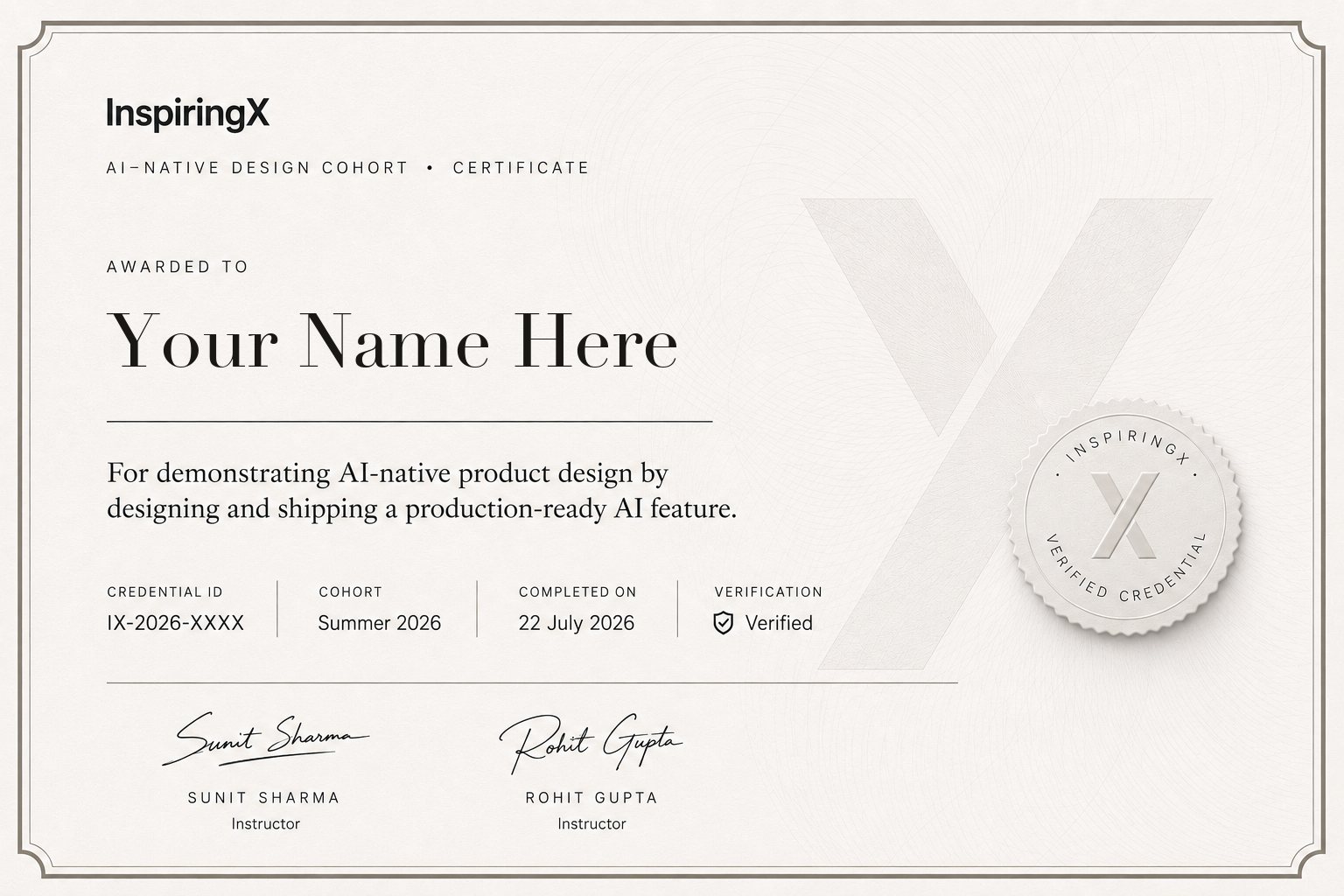
Earned, not attended.
Not an auto-generated badge. You earn it by shipping.
- Issued the day your capstone ships
- Signed by both instructors
- Verified credential, shareable on LinkedIn
Watch us build one, live.
One free session before the cohort closes. Taught exactly the way the cohort runs, on a real feature. No slides, no theory.
Check your email address and try again.
Free · this week · can't make it live? The recording goes to everyone who signs up.
Three weeks. Built live.
Three weeks, live on Zoom. A few hours a week, built for a real job. You leave AI-native: a new way of working, not new tools.
Mindset, speed, and agent setup. The judgment loop you'll run on every build for the rest of your career.
01Start with intention
Ground the AI-native mindset: what changes, what doesn't, and where your taste still runs the show.
Start with intention
Ground the AI-native mindset: what changes, what doesn't, and where your taste still runs the show.
You start by unlearning the reflex to prompt first and think later. We set the ground rules for the three weeks: AI is leverage, not a replacement for judgment. You leave day one with a clear model of where AI helps, where it hurts, and where your taste is the only thing that decides.
02Rethink fidelity & speed
Research to concept in hours, not weeks, without losing judgment along the way.
Rethink fidelity & speed
Research to concept in hours, not weeks, without losing judgment along the way.
AI collapses the old cost of fidelity: a rough idea and a polished one now take the same five minutes to generate. That's dangerous if you don't know how to use it. You'll practice compressing research and concepting into a single afternoon, and build the habit of staying skeptical of anything AI hands you too fast. You also set up your agent properly: rules, skills, and project context files, so it works like a trained teammate instead of a chat window.
03Frame, build, judge, ship
The loop you run on every AI build after this.
Frame, build, judge, ship
The loop you run on every AI build after this.
Frame the problem before you touch a tool. Build the fastest real version. Judge it against a real bar, not a vibe. Ship it like it has to survive contact with a stakeholder. This is the loop you'll run on every AI build for the rest of your career. We drill it until it's automatic.
Working prototypes wired to your design system: tokens, components, Figma MCP. Your capstone starts here.
04Prototype for real
Idea to a working, clickable build with AI, before a line of hand-code.
Prototype for real
Idea to a working, clickable build with AI, before a line of hand-code.
You'll take a real idea from your own work and turn it into a working, interactive build. Not a static mock, not a slide. Using AI prototyping tools directly, the same class of tools product teams ship with, so what you build here is a habit you keep after the cohort ends. You wire in your own design system as you go: design tokens, components, and Figma MCP, so the prototype looks like your product, not a template.
05Your capstone begins
Scope a real feature from your own work and start building it, reviewed live every week.
Your capstone begins
Scope a real feature from your own work and start building it, reviewed live every week.
This is the project that anchors the whole cohort. You scope a real feature (something from your actual job, not a made-up brief) and start building it live, with both instructors reviewing your direction every week. By the end of week two it's a working prototype, not a plan. And because your capstone is an AI feature, you work the design-for-AI patterns directly: trust, confidence states, and what good AI UX actually looks like.
06Judge what AI made
Spot confident-sounding-bad output and fix it with a real eval, not a gut feeling.
Judge what AI made
Spot confident-sounding-bad output and fix it with a real eval, not a gut feeling.
AI is confident even when it's wrong. That's the trap. You'll learn to run a real eval against your own output: a repeatable way to tell "looks done" from "is done," so you stop shipping work that only survives a demo.
Version control, a live deploy, demo day, and the certificate you earn by shipping.
07Ship it for real
Your capstone goes from working prototype to production-ready, personally reviewed.
Ship it for real
Your capstone goes from working prototype to production-ready, personally reviewed.
The gap between a working prototype and something you'd actually ship is where most AI-assisted work falls apart. You'll close that gap on your own capstone, personally reviewed line by line, until it's not a demo anymore: it's a real, production-ready artifact, taken through version control and a live deploy, the same path a production feature travels.
08Defend it · demo day
Present your build to the room and defend the decisions behind it.
Defend it · demo day
Present your build to the room and defend the decisions behind it.
You present your capstone to the full cohort and defend the calls you made: why this framing, why this tradeoff, why this is done. This is the room your work has to survive after InspiringX: stakeholders who ask "why," not just "is it pretty." You leave knowing you can hold your own in it.
09Earn your certificate
Ship your capstone and it's yours: signed by both instructors, verified, shareable.
Earn your certificate
Ship your capstone and it's yours: signed by both instructors, verified, shareable.
The certificate is issued the day your capstone ships. Not for attending: for shipping. Signed by both instructors, carrying a verified credential ID, ready to share on LinkedIn.
- Spot AI output that sounds right but isn't
- Turn a rough idea into a judged concept in hours
- Keep your taste as the filter, not the AI
- Tell real AI-native work from bolted-on AI
- Go from Figma to a clickable, working build
- Use Cursor, Claude Code and v0 without becoming an engineer
- Prototype fast without losing craft
- Ship UI that survives a real product review
- Run a real eval, not a vibe check
- Take a build from demo-ready to production-ready
- Defend your decisions in the room
- Repeat it with The Ship Checklist, on whatever AI tool comes next
Claude · ChatGPT · Figma AI
Cursor · Claude Code · v0
Evals · The Ship Checklist
Tools change every month. We teach the ones that matter now, and the judgment that outlasts all of them, so you're never dependent on a single app.
 Claude
 ChatGPT
 Figma
Figma Cursor
 v0
v0The full program, up front. Free.
Check your email address and try again.
The full 3-week outline, the four-step build process, and 5 starter prompts · straight to the pack, no sales call.